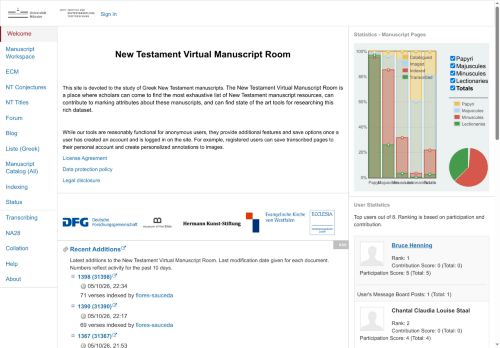
This is an academic research tool. It maintains the official catalogue of Greek NT manuscripts and provides manuscript images, transcriptions, data, and sophisticated research tools. Peter Gurry calls it effectively indispensable to contemporary academic text-critical work. It is not a confessional evangelical resource, so use it for primary data rather than theological framing; nevertheless, serious evangelical textual critics use it constantly.
This site is devoted to the study of all known Greek New Testament manuscripts and includes the most comprehensive repository of images, transcriptions, and metadata. The New Testament Virtual Manuscript Room is a place where scholars can come to find the most exhaustive list of New Testament manuscript resources, can contribute to marking attributes about these manuscripts, and can find state of the art tools for researching this rich dataset.
Manuscripts, New Testament, Textual Criticism, Nestle-Aland, Greek New Testament, Editio Critica Maior, New Testament Manuscripts, Images, Transcriptions, P46, Sinaiticus, Vaticanus, Bodmer, Chester Beatty
Date last visited: 2026-10-06
https://ntvmr.uni-muenster.de/